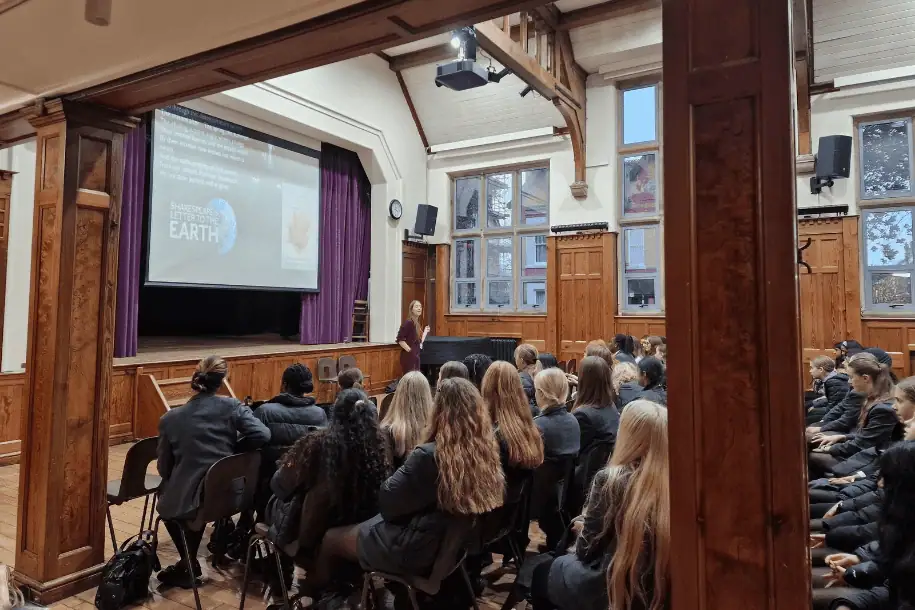
Academic Extension Day at LHS gives pupils the opportunity to hear from members of staff and guest speakers on a wide range of subjects and topics, all connected by a common theme.
This term, Year 9 and 10 pupils explored Change and Transformation. The programme offered a breadth of perspectives, with 19 talks and workshops examining the theme across the arts, sciences and wider world.
Examples of sessions included:
Transforming ourselves through performance – In this practical workshop, students explore how we transform ourselves in front of a live audience. Through voice work and physical activities, everyone takes part in developing performance and communication skills.
How technology transforms the world – Students investigate six technologies, from printing to generative AI, considering their benefits, disadvantages and unexpected effects. They debate whether artificial intelligence will have a greater impact than the printing press.
Tracing female beauty in literature – From 1400 to the present day, students explore how literature defines and represents female beauty. They consider how these ideals have changed over time and make predictions about the future.
The science of transformation – Can everything be transformed, and can every transformation be reversed? Students explore scientific change and consider what makes a transformation reversible or irreversible.
Shakespeare Transformed
Jen Waghorn (LHS 2008) is a lecturer in Shakespeare and also works for English Heritage looking at the importance of history and why it matters. She has also adapted Shakespeare into music for a musical based on Twelfth Night. Jen delivered a fascinating talk looking at how over 400 years Shakespeare has been transformative himself, the ways Shakespeare and his work has been transformed and how we can use Shakespeare ourselves to transform the world around us.
The talk began by exploring how Shakespeare became a cultural phenomenon, with his words used by politicians and artists, including Stormzy. In fact, there is an estimate that some kind of production of Hamlet is performed every minute of the day. When Shakespeare started writing plays, the theatre industry in England was only around 20 years old, and it was a period of significant change when people were rethinking religion, science and language. In this new industry Shakespeare had the opportunity to tell stories and change the audiences lives for two hours. However, work is always being transformed. Many of his plays rework existing stories and once he dies in 1616, his fellow actors are already reshaping his plays in the same year, such as adding songs and a singing cat to Macbeth!
The endings, in particular, have often been altered. Nahum Tate’s version of King Lear replaced the tragic ending with a happier one, which was performed for 100 years. Lope de Vega’s Spanish play Castelvines y Monteses, which draws on the same story as Romeo and Juliet, also offers a happier ending.
Shakespear’s stories have inspired countless adaptations, too. They are referenced in many familiar films, especially sci-fi like Forbidden Planet, which draws on The Tempest, as well as Star Wars and Doctor Who.
Jen also considered how modern theatre-makers reinterpret Shakespeare to make his work meaningful to contemporary audiences. The Royal Shakespeare Company’s 2022 production of Much Ado About Nothing, for instance, reimagined the play in an Afrofuturist world, with one of Beyonce’s designers doing the costume design. There are also many adaptations of Macbeth, with lots of actors taking the role as they can put their own spin on Shakespeare and show off their acting style.
The talk then turned to how Shakespeare has transformed our own perception of history. In Macbeth, Shakespeare portrays the king as a “Butcher”, a murderous tyrant. However, historical accounts suggest that actually Macbeth was a good king.
Shakespeare’s work has often been used in political history, using Shakespeare rhetorically to make their own points. His writing often invites audiences to imagine life from another person’s point of view. Jen discussed how Nelson Mandela resonated with and signed the famous speech from Julius Ceaser in 1977 in a copy of Shakespear’s complete works when he was a political prisoner. This passage has also been translated and used in Ukraine as a rallying cry. Another example is the speech from the play Sir Thomas More, which is used by lots of refugee charities to show empathy for foreign “strangers”.
Jen ended the session looking at Shakespeare’s role in science and technology. His influence can be found in video games, while some of his characters’ names have been given to moons of Uranus. Neuroscientists are currently studying how the brain responds when listening to his distinctive language. Initial research shows higher brain activity. Shakespeare can even be related to climate change. Tatiana’s speech in A Midsummer Night’s Dream, which describes the disruption of the natural world, can be used to think about the future and world around us.
The talk concluded that Shakespeare is perfect for taking apart and being adapted and thinking how is this relevant to me, how does this speak to me? More than 400 years after his death, Shakespeare’s stories and language are still being transformed – and continue to offer new ways of seeing the world.