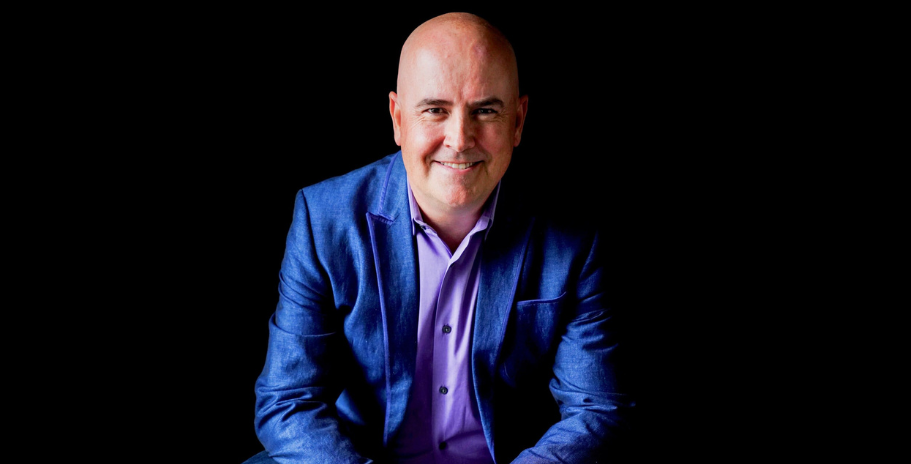
Steve Brown (LGS 1985) is an AI Futurist, Entrepreneur, and Author, and a leading voice in the conversation on Artificial Intelligence. He has delivered hundreds of engaging, information-rich keynotes across five continents, inspiring audiences to take action with AI.
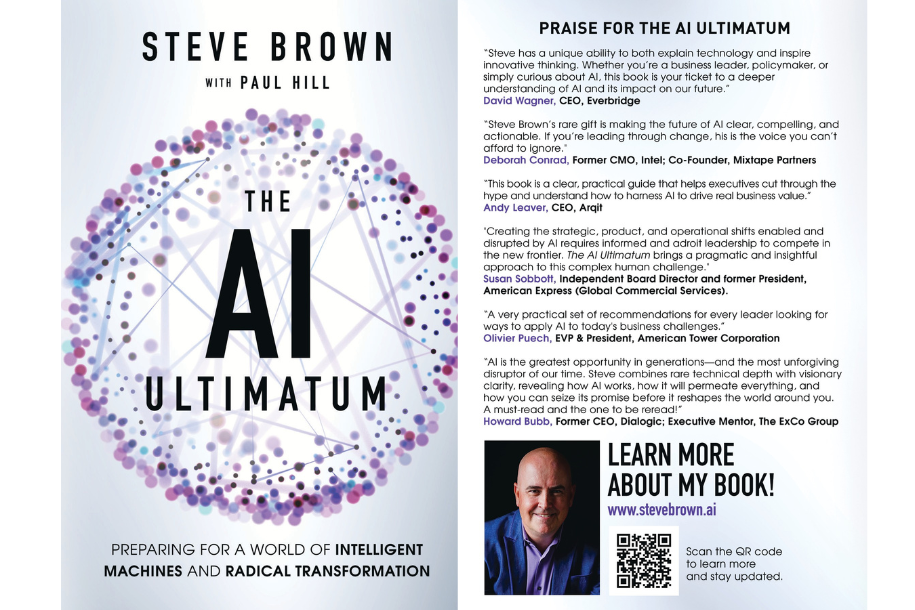
Steve has recently published his second book, The AI Ultimatum: Preparing for a World of Intelligent Machines and Radical Transformation, following the success of his bestselling first book, The Innovation Ultimatum.
Here, Steve reflects on his time at LGS and shares insights from his career.
1. For those who haven’t come across it yet, what inspired you to write The AI Ultimatum and what do you hope reader will take away from it?
I work with a broad range of companies to help them develop their AI strategies, and I kept hearing the same challenge: “We know AI is important, Steve, and we know we need to act, but we aren’t sure how to get started or where to focus.” So I wrote a book for business leaders, aspiring leaders, and people interested in how AI will shape our future, to point them in the right direction and provide frameworks and tools to implement AI successfully to do good for people. Think of it as a handbook on AI for business leaders.
2. Your career has taken you around the world and into some of the most exciting areas of technology. What initially sparked your interest in innovation and AI?
I’ve been fascinated by AI and the future since I was a boy. I used to get to school early at LGS so I could have a little extra time with the computers in the P-Block (is that still there?!) because it was clear to me back then that computers would shape our future and become incredible tools.
3. You spend some time working at Google DeepMind in London. What was that experience like and did anything from that period directly influence your new book?
I learned so much working for DeepMind. They’ve assembled some of the sharpest AI research minds on the planet, and it was a true honour to work alongside them. I got a front row seat on how they think about building so-called AGI (Artificial General Intelligence—human-level intelligence) and I got to think deeply about the ethical and practical implementation of AI. A lot of that shows up throughout the book.
4. Looking back, what are your strongest memories of LGS?
Ones you can print? Hmm, I remember the amazing teachers, being hit in the ear by a cricket ball as I walked past the cricket field on the way to a Latin lesson, being forced to play rugby in driving cold rain, and the custard in the lunch hall. Wow, that was good custard. Especially the chocolate custard they made sometimes. The stuff of dreams.
5. Were there any teachers or subjects at LGS that particularly shaped your interests or the direction your career eventually took?
My maths teacher, John Fernandez, was terrific. I won the school maths prize the year I graduated, and he was an amazing teacher. Mr Flynn was great too because he took an early interest in computers and drove the school board to invest more in buying early computers (Commodore Pets, the Apple II, etc…look them up). And Mr Campbell was different, but he made sure my French accent was good enough to fool French people into thinking I was a native. That still gets me into trouble today.
6. If you think about the path your life has taken, are there any lessons or habits from your days at LGS that you still value today?
Be constantly curious, be kind to others, and never think you’re the smartest person in the room…there’s always somebody you can learn something from. Always.
7. Computer Science is now one of the most popular university choices among our students. What skills or mindsets do you think young people should be developing as they enter an AI driven world?
Make sure you’re good at learning. Learn to learn well. We are about to go through an unprecedented period of change. Being adaptable, curious, and capable of learning new skills (in particular, learning how to use AI to amplify yourself and all that you can do) is what will separate you from the masses.
8. If you could speak directly to current LGS pupils, what would you want them to know about the opportunities and responsibilities of working with emerging technologies like AI?
AI will transform work, education, healthcare, the economy, and ultimately society itself. As Eric Schmidt, the former CEO of Google, has said, “AI is the most important thing that’s going to happen in about 500 years, maybe 1000 years in human society, and it’s happening in our lifetimes.” Invest in yourself. Learn how to use AI. You don’t need to know how to build it. But you do need to understand how to use it; How to harness it to amplify your own abilities and increase your impact. Build your AI acumen and learn to use AI tools and agents. Maybe you’ll be the first person to start a billion-dollar company with only one employee…you.
9. Is there anything you wish your 16-year-old self at LGS had known back then about the future that lay ahead?
I was more shy when I was a kid. Not introverted, but quieter and shy. Once I made it to uni, I became a DJ, put on bands, and now I stand on stages with an audience of up to 10,000 people and speak for a living. If I could talk to my 16-year-old self, I’d tell myself always believe in yourself because your abilities will emerge over time.
10. What’s next for you? Are there any future projects, ideas or challenges you’re looking to explore?
I’m fascinated to decode what will happen to society and the economy more broadly as AI evolves and is deployed at scale. There is a period of massive disruption ahead. People leaving school today may have short careers and extended lifespans. AI will reduce the need for work, improve healthspans (our healthy years), and reduce the price of goods and services. It’s massively disruptive, and I’d like to help people through that transition in some way. It’s one of the reasons I wrote the book (read chapter 11!)
11. Is there anything else you’d like to share with the Alumni and School Community?
AI can be scary. We’ve all seen The Terminator, The Matrix, Ex Machina, and a ton of dystopian movies about the future. We should be cautious about the future, but not let James Cameron define how we should feel about what comes next. I call myself a futurist. I deputise every reader of this article as a junior futurist. We must all participate in defining the future we want. And the future we wish to avoid. Throughout history, culture and technology have collided, each shaping the other. AI has incredible potential to cure disease, yield abundant energy (with fusion technology), and accelerate scientific discovery. It could also lead to increased isolation (avoid AI girlfriends/boyfriends at all costs), mass surveillance, and massive inequality. AGI is coming. It’s never too late to engage in conversations about how we will use AI to make things better for people and what kind of world we want to build in an era of abundance. Today, we often get wrapped up in our careers, the rat race, and trying to establish ourselves. We forget to ask ourselves the three most important questions of life:
1) Who am I? (Clue: the answer is not your job title)
2) What makes me happy?
3) What’s important/worthwhile to me?
In a post-labour world, when AI and robots do most of the work for us, we may all live lives of abundance with little worry, other than asking, “What shall I do today?” Answering these three questions now gives you the framework you’ll need to flourish in such a world.